
Your control pack knows more than your strategy day.
31 tested ideas for great fundraising, on one free poster. Print it. Stick it on the wall. Point at it in meetings

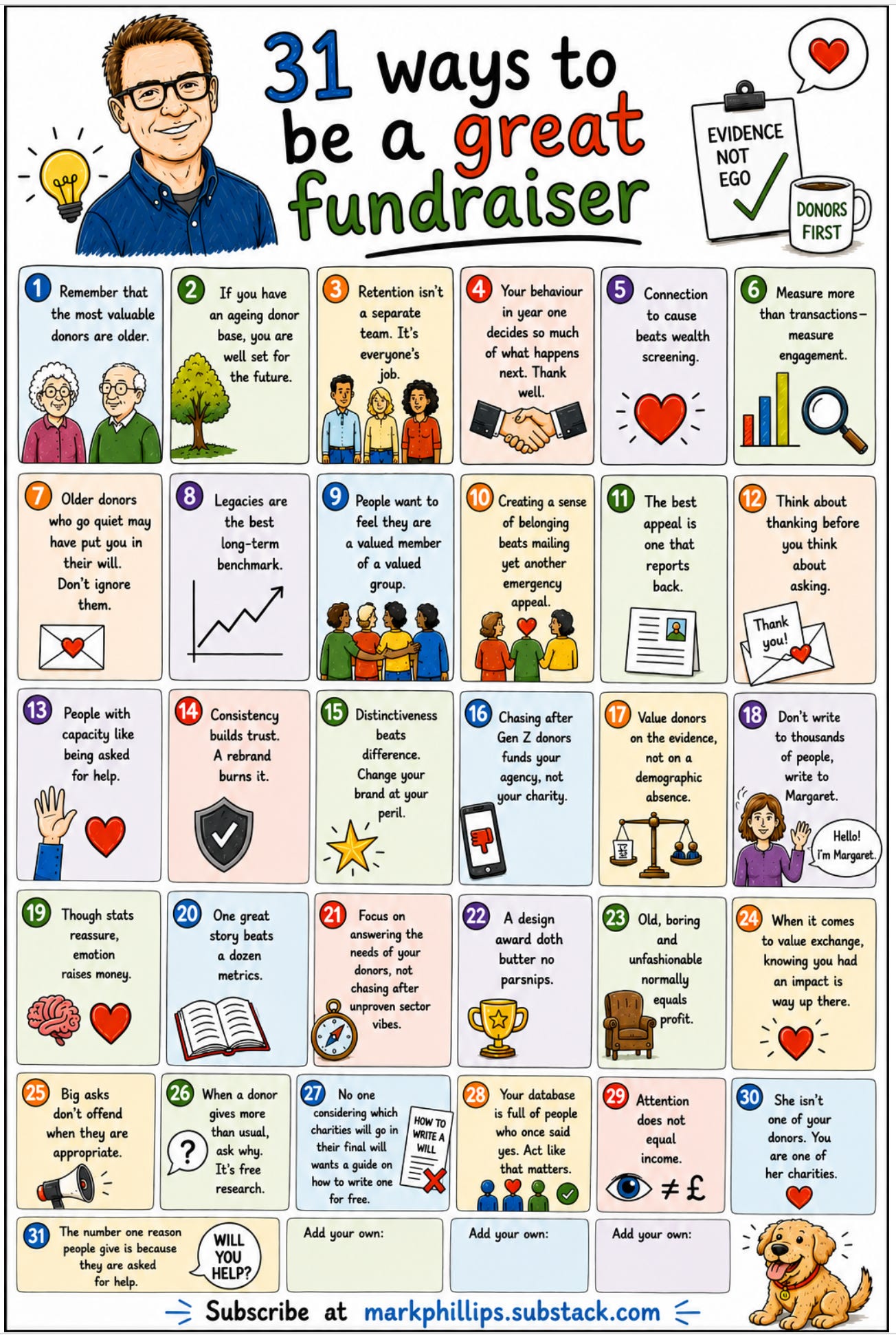
Fundraising has no shortage of advice. What it has a shortage of is advice that’s actually been tested.
So before you download this free poster (the PDF is at the bottom of this post), I want to be clear about what it is and isn’t.
It isn’t a list of opinions. It isn’t 31 things that sounded good on a screen in a pitch. Every idea on this chart comes from one of three places: results from real campaigns and real tests, research into why donors actually give, stay and leave, or sector data gathered over decades. Evidence, not ego. It’s on the chart for a reason.
Where these ideas come from
Take the ones about older donors – ideas 1, 2 and 7. They’re not sentiment. UK giving data consistently shows donors over 65 give more than twice as much per year as donors under 35, retain at nearly double the rate, and are six times more likely to include a charity in their will. Model that over ten years and an older cash donor can be worth over twelve times her younger equivalent. An ageing donor base isn’t a crisis. It’s fantastic strategy in action.
Or idea 7 specifically – older donors who go quiet may have put you in their will. That comes from research showing giving naturally declines in the final few years of life –exactly when people are writing and updating wills. Charities that stop communicating with “lapsed” older donors in the name of tidy data are deleting their own legacy pipeline. We know this because it’s been measured.
The retention ideas – 3, 4 and 12 – reflect on the most reliable findings in the sector: what happens in a donor’s first year predicts almost everything after it. Retention studies repeatedly show poor communication as the top reason donors stop giving, and that a proper thank-you and welcome dramatically boosts twelve-month retention and second gift rates. Thanking properly before asking again isn’t politeness. It’s good fundraising.
The belonging ideas are 5, 9 and 10. They are grounded in donor research too. Engagement studies of thousands of UK supporters show that psychological connection – feeling like a valued member of a valued group – predicts long-term value and legacy consideration far better than gift size does. Connection to cause beats wealth screening because it’s about what actually matters.
And the unfashionable ones – 15, 21, 23 – come straight from testing. Controls exist because opinions fail. The boring pack that’s won for eleven years keeps winning against the exciting new concept, the award-winner underperforms the ugly one, and distinctiveness built over years beats difference invented last quarter. Anyone who has run a proper test programme has the scars to prove it. Idea 22 – a design award doth butter no parsnips – is simply eleven years of results files, compressed.
Even the last idea, the simplest one, is evidence. Ask people why they gave and the top answer, decade after decade, study after study, is the same: because someone asked them.
How the 31 break down
So when we add this to the rest, the chart isn’t really 31 separate ideas. It’s five, wearing clustered together:
Value the donors you have (1, 2, 7, 8, 17, 30) because the data on older and existing donors is overwhelming, and the fantasy audience is the donors you have already,.
Retention is the engine (3, 4, 11, 12, 28) because first-year behaviour, thanking and reporting back are the best ways to keep and upgrade donors.
Build belonging, not transactions (5, 6, 9, 10, 13, 18, 24) because engagement research shows connection predicts lifetime and legacy value better than money does.
Trust evidence over fashion (14, 15, 16, 21, 22, 23, 26, 29) because the control keeps beating the clever idea, and attention keeps failing to turn into income.
Ask properly (19, 20, 25, 27, 31) because emotions raise money, stories carry it, and people give when asked.
That’s it. 31 ideas. The rest is execution.
Stick it on your wall
I made this a poster deliberately. Not a report, not a webinar, not a ten thousand word essay (even though I know you love them). A poster, because the point of these rules isn’t to read them once and nod. It’s to have them in your eyeline when someone suggests replacing your current donors with Gen Xers, rebranding because the new director likes rebranding, or diverting the retention budget into innovation.
Download it. Print it A3 if you can. Put it where your team meet – or better still, where your senior leadership team holds meetings. There are three blank boxes at the bottom for a reason – add the rules you’ve learned from your own testing, because your evidence counts too. I’d love to hear what you put in them. If I get 31, I’ll build a second poster as a partie deux.
Download the poster here

Wonderful insights! Thanks for contributing to this conversation. We recently published a guide aimed at helping nonprofits navigate financing with more confidence. If you're interested, here's the article: https://thesemblereview.substack.com/p/what-you-need-to-apply-for-non-profit